AI Ethics · Politics · Digital Media · Cybersecurity
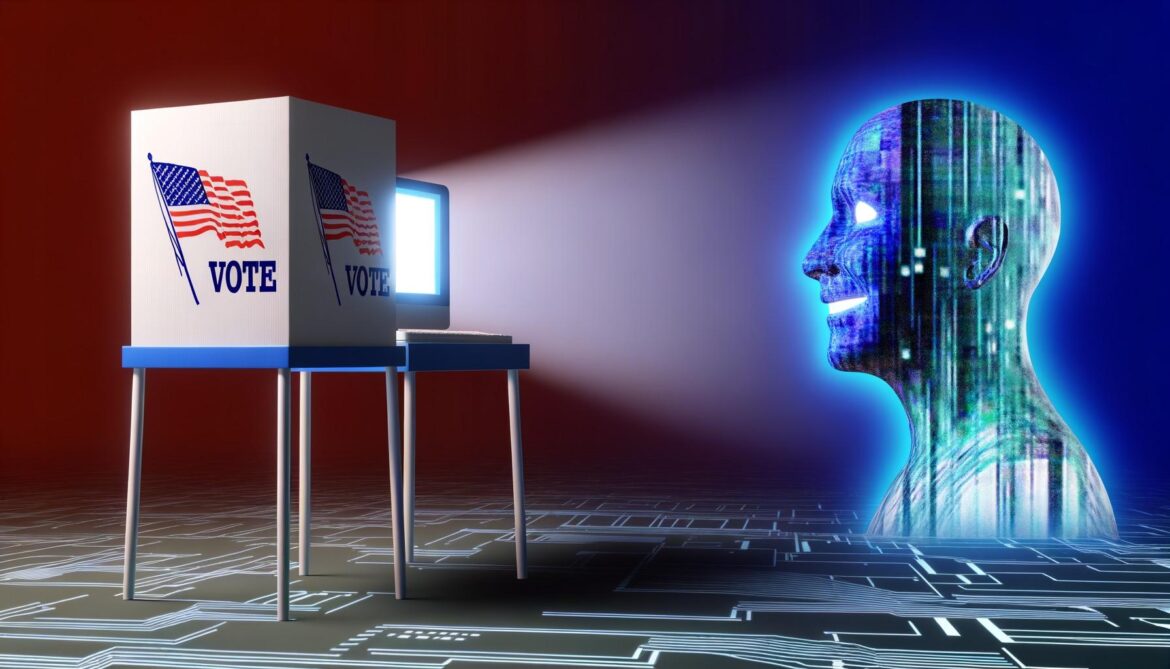
Artificial intelligence is changing how political information is created, shared, and consumed. AI-generated videos, cloned voices, synthetic images, and realistic political advertisements can make it difficult for voters to distinguish authentic statements from fabricated content. As the United States approaches its November 2026 midterm elections, the challenge of maintaining trust in digital political communication has become an important research topic.
The central question is not simply whether AI can generate convincing political deepfakes. It is whether disclosure labels, digital provenance systems, independent fact-checking, and media literacy can help people evaluate political content accurately without restricting legitimate political expression.

What Is an AI Deepfake in Political Campaigning?
An AI deepfake is synthetic or manipulated media created with artificial intelligence to imitate a real person’s appearance, voice, expressions, or actions. Deepfakes can appear in videos, audio recordings, photographs, social media posts, and political advertisements.
In election campaigns, these tools can be used in different ways. A campaign might generate a fictional scene to criticize a candidate, imitate a politician’s voice to make it appear that they made a statement, or alter a genuine recording to change its meaning. Some AI-generated advertisements are intended as obvious satire, while others may be designed to create a misleading impression.
The distinction matters. Using AI in political communication is not automatically misinformation. The central concern is whether content deceives people about what happened, what a candidate said, or where a piece of information came from.
Why AI Deepfakes Are Becoming an Election Concern
AI image, video, and voice-generation tools can make realistic synthetic content easier to produce than traditional video manipulation. Campaign teams and political groups can create multiple variations of an advertisement, adapt content for different audiences, and distribute it across social media platforms.
Recent reporting illustrates how this technology is appearing in US election advertising. On October 19, 2026, Axios reported on AI-generated attack advertisements appearing in campaigns ahead of the November midterms. Earlier research from the Wesleyan Media Project, published in October, documented nearly 170 AI-generated or AI-enhanced political advertisements, associated with approximately $80 million in spending at the time of its analysis. The researchers also found that disclosure practices varied substantially.
These figures describe a developing advertising landscape, not the number of voters deceived or the proven effect on election outcomes.
Several factors make the issue important:
- Realistic impersonation: Synthetic media can make it appear that a candidate said or did something that never happened.
- Rapid distribution: Misleading clips can spread through messaging apps, social platforms, and reposts before corrections reach the same audience.
- Emotional impact: Content involving anger, fear, scandal, or outrage may attract attention before viewers check its authenticity.
- Unclear disclosure: Small labels or vague wording can make it difficult for viewers to understand whether an advertisement contains synthetic media.
- Declining trust: Repeated exposure to fabricated content may encourage people to distrust genuine recordings as well as false ones.
The last concern creates a particular challenge: deepfakes can cause harm even when they are eventually exposed, because the resulting uncertainty may persist.
How Political Deepfakes Can Influence Voter Understanding
The potential effects of synthetic political media extend beyond a single misleading video.
Fabricated statements and events
A manipulated recording could portray a candidate making a controversial statement, accepting an inappropriate offer, or expressing a position that differs from their documented public record. Even if the content is later debunked, some viewers may remember the allegation without remembering the correction.
Misleading context
Not every harmful political deepfake invents an entirely new event. AI can modify a real photograph, change a speaker’s voice, or place authentic footage in a fictional setting. Other advertisements use exaggerated or absurd imagery that is intended as parody but may still shape perceptions of a candidate.
False voting information
Synthetic audio or video can impersonate election officials or trusted public figures. If it provides incorrect information about polling locations, registration, voting dates, or eligibility, it may interfere with people’s ability to participate in an election.
The liar’s dividend
A related problem is the liar’s dividend: someone can dismiss authentic evidence by claiming that it was generated by AI. As synthetic media becomes more common, people may become uncertain about genuine recordings, making verification more difficult.
These risks should not be confused with proof that deepfakes determine voting behaviour. Establishing their actual effects requires careful research into exposure, credibility, voter responses, and the wider information environment.
Can Disclosure Labels Help Voters Identify AI Deepfakes?

Disclosure labels are one of the most direct ways to inform viewers that political content has been generated or substantially manipulated using AI. A label might state that a video contains AI-generated imagery, that a voice has been synthetically recreated, or that a scene does not depict a real event.
For labels to be useful, they should be visible, understandable, and displayed before or while people encounter the content. A brief warning in tiny text may technically provide disclosure without helping viewers make an informed judgment.
Effective disclosure systems should address several questions:
- Does the label clearly identify the AI-generated or manipulated portion?
- Can viewers read or hear the warning on mobile devices?
- Does the label distinguish fictional satire from a realistic but fabricated event?
- Is the disclosure retained when advertisements are reposted or reformatted?
- Can viewers easily identify the campaign or organisation responsible for the advertisement?
The 2026 US campaign experience highlights the limits of relying on voluntary disclosure alone. An October report from the Associated Press described AI-generated campaign advertisements appearing without the disclosures required under some state laws. It also documented differences between satire and content that could mislead audiences.
Labels are therefore an important starting point, but they are not proof that viewers will understand the content or that an advertisement is truthful.
Digital Provenance: Tracing Where Political Content Comes From
Digital provenance systems attempt to establish the origin and editing history of images, videos, and audio recordings. Instead of asking only whether a video looks suspicious, they provide information about how a file was created and subsequently modified.
One prominent approach is C2PA (Coalition for Content Provenance and Authenticity). Its Content Credentials standard can attach cryptographically verifiable information about a digital asset’s origin and editing history.
For political advertising, provenance could help journalists, election observers, platforms, and viewers establish whether a recording has been edited or generated using a supported tool.
How digital provenance can support election transparency

Content creation
A camera or supported software records information about the original file and the tools used to create or edit it.

History verification
Verification software checks available credentials and signatures to help identify the file’s documented history.

Independent assessment
Journalists and fact-checkers compare the file’s history with original recordings, reliable reporting, and other evidence.
However, provenance is not a universal deepfake detector. Metadata may be removed during editing, screenshots, or social media sharing. A file without credentials is not necessarily fake, while a valid credential does not prove that the events shown are genuine. These limitations are documented in the C2PA explainer and technical guidance.
For this reason, digital provenance should complement visible labels, fact-checking, and investigative journalism rather than replace them.
Can AI Detection Tools Identify Fake Political Videos?
AI detection systems analyse digital media for patterns that may indicate synthetic generation or manipulation. Depending on the tool, they may examine facial movements, voice characteristics, image inconsistencies, compression patterns, or other technical signals.
Such tools can help investigators prioritise suspicious content, particularly when many videos are circulating simultaneously. But their results require careful interpretation.
A detection tool might incorrectly flag genuine content or fail to recognise a sophisticated deepfake. Its performance may also vary when content is compressed, cropped, edited, or generated using unfamiliar AI models.
The US Government Accountability Office has identified limitations in real-world deepfake detection and noted that detection alone may not prevent misinformation from spreading.
A practical verification process should therefore combine technical analysis with human judgment. Investigators can compare the disputed recording with the full original speech, examine its publication history, contact the relevant campaign, and seek independent confirmation.
The key principle is that a detection score should be treated as evidence to investigate, not a final verdict about authenticity.
Media Literacy: Helping Voters Think Critically
Technology cannot address the deepfake problem on its own. Voters also need practical skills to assess online political information.
Media literacy does not mean teaching people to reject every unfamiliar video or assume that all political content is manipulated. Instead, it encourages viewers to assess sources, check context, compare evidence, and recognise when further verification is necessary.
Research and expert guidance reviewed by the UK Government Office for Science identifies media literacy as a useful way to build resilience against disinformation, while acknowledging that evidence about the effects of deepfakes on actual voting behaviour remains complex.
Here are five practical habits voters can use when they encounter a surprising political video.
A voter verification checklist
0 of 5 checked
Check the original source
Find the original campaign, news organisation, public statement, or complete recording rather than relying on a repost.
Look for independent confirmation
Check whether multiple credible outlets report the same event and whether their evidence is independent.
Read the full context
A short clip may omit important sentences, use old footage, or present satire as a genuine statement.
Inspect the disclosure
Look for notices about AI-generated voices, altered footage, fictional scenes, or synthetic images.
Pause before sharing
If the claim is sensational or could seriously affect someone’s reputation, verify it before forwarding it to others.
These habits are useful beyond US elections. In India, for example, the same approach can help voters assess viral political clips shared through messaging applications and social media during national, state, and local elections.
The Role of Governments, Campaigns, and Social Media Platforms
Responsibility for reducing election misinformation should not rest entirely on individual voters. Governments, political campaigns, technology companies, news organisations, and civil society groups each have a role.
Governments can establish clear disclosure requirements for materially deceptive synthetic political content, define enforcement procedures, and provide appropriate safeguards for satire, artistic expression, journalism, and legitimate political speech.
Political campaigns can disclose synthetic media prominently, retain records of their advertisements, identify their sponsors, and avoid presenting fabricated events as authentic evidence.
Social media platforms can improve reporting mechanisms, make political-advertising archives more transparent, label synthetic media where reliable information is available, and limit the rapid spread of demonstrably deceptive content while providing meaningful opportunities for review and appeal.
News organisations and independent fact-checkers can publish timely corrections, explain how claims were verified, and make original evidence available where possible.
International approaches are also evolving. The European Commission’s guidance on the EU AI Act describes disclosure obligations for deepfake content in relevant circumstances, including the need for clear and distinguishable notices. Specific requirements depend on the applicable legal provisions and context.
No single policy or technical measure will eliminate synthetic political misinformation. A combination of transparency, enforcement, reliable verification, and public education is more likely to address the different ways it spreads.
Research Questions: What Should Scientists Investigate Next?
The growing use of AI-generated campaign advertisements creates several important research opportunities.
| Research area | Key question |
|---|---|
| Disclosure labels | Do prominent, plain-language labels improve viewers’ understanding of synthetic political content? |
| Digital provenance | How reliably do provenance credentials survive editing and redistribution across platforms? |
| Media literacy | Which educational approaches help people verify political claims without making them distrust authentic evidence? |
| Deepfake detection | How accurately do detection tools perform on unfamiliar models, compressed videos, and real campaign material? |
| Voter behaviour | Does exposure to fabricated political media change candidate perceptions, political trust, or intended participation? |
| Regulation | How can disclosure rules reduce deception while protecting satire and legitimate political expression? |
Researchers could investigate these questions through controlled experiments, surveys, interviews, and analysis of publicly available campaign advertisements.
For example, an experiment could show participants the same political video under three conditions: without a label, with a clear AI disclosure, and with a disclosure plus a link to provenance information. Researchers could then compare whether participants correctly identify the content’s origin, remember its claims, and distinguish factual evidence from fictional scenes.
Such studies should also measure possible unintended consequences. A warning may be overlooked, misunderstood, or cause people to distrust genuine material. Researchers should examine these outcomes rather than assuming that a label automatically solves the problem.
Conclusion
AI deepfakes in elections represent a challenge for digital media, political communication, and public trust. As synthetic images, cloned voices, and AI-generated campaign advertisements become more common, voters need ways to distinguish authentic evidence from fabricated or misleading content.
Disclosure labels can provide immediate warnings, provenance systems can reveal aspects of a file’s history, and AI detection tools can help investigators examine suspicious material. Media literacy enables people to use these signals more thoughtfully, while transparent campaigns, accountable platforms, and proportionate regulation can strengthen the wider information environment.
None of these measures is sufficient alone. Provenance does not establish truth, detection systems can make mistakes, and even clear disclosures may not prevent misleading impressions.
The most productive research direction is to evaluate how these approaches work together in real-world conditions. The goal should be an election information environment in which people can examine political claims critically, access trustworthy evidence, and make independent decisions without being misled by fabricated media.