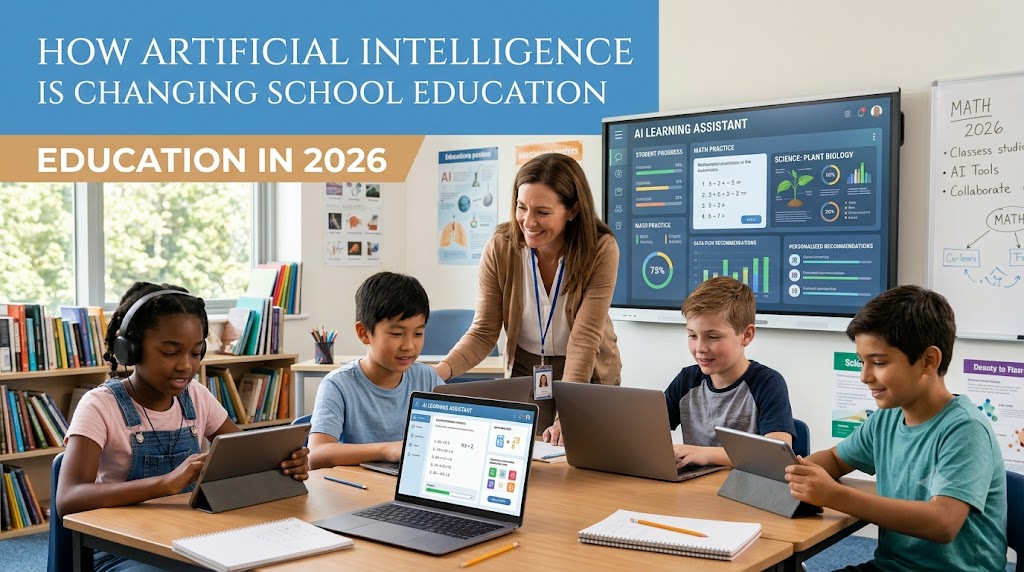
Artificial intelligence is transforming school education in 2026 by changing how students learn, how teachers prepare lessons, and how schools evaluate academic progress. From AI-powered tutors and personalised learning platforms to automated feedback and interactive digital classrooms, modern educational technology is creating new opportunities for learners across different age groups.
However, the growing use of generative AI also raises important questions. Can students learn effectively if they depend too much on AI-generated answers? How can teachers distinguish genuine understanding from machine-generated assignments? And how can schools ensure that AI makes education more inclusive rather than increasing the digital divide?
The future of school education will depend not simply on how quickly schools adopt AI, but on how responsibly they integrate it into teaching and learning.


What Is AI-Powered School Education?
AI-powered school education refers to the use of artificial intelligence tools to support teaching, learning, assessment, and classroom administration. These systems can analyse learning activities, respond to questions, generate practice exercises, explain difficult concepts, and help teachers prepare educational resources.
Traditional classroom teaching generally follows a common lesson plan for the entire class. Although teachers can adapt their explanations, individualising every lesson for every student is difficult, especially in classrooms with many learners.
AI tools can help address this challenge by providing additional explanations, exercises, and feedback based on a student’s progress. For example, a student struggling with fractions may receive simpler examples and guided practice, while a student who has mastered the topic can move on to more challenging problems.
Generative AI tools can also explain scientific concepts, help students practise a foreign language, summarise reading material, and support creative projects. Their usefulness, however, depends on the accuracy of their responses, the quality of the learning activities, and the guidance provided by teachers.
AI should therefore be viewed as a support system for education rather than a replacement for human teaching.
How AI Tutors Are Supporting Students in 2026

One of the most significant developments in AI-powered education is the emergence of intelligent tutoring systems. These tools can provide students with explanations, hints, questions, and feedback whenever they need additional support.
In a traditional classroom, a teacher may not always have enough time to address every student’s doubts individually. An AI tutor can offer an additional learning resource outside school hours, allowing students to revisit difficult concepts and practise at their own pace.
For example, a student learning algebra can ask an AI tutor to explain how to solve a linear equation. Instead of immediately providing the answer, a well-designed educational tool can break the problem into smaller steps, ask the student to attempt the next step, and offer a hint when the student gets stuck.
Similarly, students studying science can use AI to explore topics such as the water cycle, electricity, photosynthesis, or the human digestive system. Language learners can practise vocabulary, sentence construction, and conversational exercises.
The greatest benefit comes when AI encourages students to think rather than simply supplying completed answers.
Making Additional Learning Support More Accessible
AI tutors may be particularly helpful for students who hesitate to ask questions in front of classmates. A student can repeat a question, request another explanation, or practise a concept without worrying about embarrassment.
AI can also support revision before examinations. Students can request practice questions, flashcards, concept summaries, and quizzes based on the subjects they are studying.
However, schools should verify that AI-generated explanations and practice questions match the prescribed syllabus and are factually correct. AI tools can make mistakes, and students may struggle to recognise incorrect information if they lack sufficient subject knowledge.
For younger learners, parental supervision and teacher guidance remain essential.
Personalised Learning: A Classroom Designed Around Individual Needs

Every student learns differently. Some understand a concept after reading a textbook, while others need diagrams, demonstrations, repeated exercises, or practical examples. Personalised learning uses information about a student’s progress and learning needs to make educational activities more suitable for that individual.
AI can help teachers create this flexibility by adapting the difficulty of exercises, recommending revision activities, and identifying areas where students may need further support.
Adapting Lessons to Different Learning Levels
Imagine a classroom in which students are studying fractions. Some learners can already add and subtract fractions confidently, while others are still trying to understand equivalent fractions.
An AI-supported learning platform may recommend introductory activities for students who need additional practice and more challenging problems for those who have mastered the basics.
This approach can reduce unnecessary repetition for advanced learners while giving struggling students more opportunities to develop foundational skills.
Personalisation can also be useful in reading education. A digital platform may recommend texts appropriate to a student’s reading level, provide vocabulary explanations, and offer comprehension questions to check understanding.
Nevertheless, AI should not permanently label a student as weak or advanced based on a few incorrect answers. Learning progress can be affected by fatigue, language barriers, technical problems, or temporary difficulties. Teachers must interpret performance data in context.
Supporting Students With Different Educational Needs
AI-assisted tools may offer additional accessibility features for students with disabilities or learning difficulties. Depending on the platform, these can include speech-to-text, text-to-speech, captions, simplified explanations, visual descriptions, and alternative ways to interact with learning material.
For example, a student with reading difficulties may benefit from listening to digital text while following the words on screen. A student with hearing difficulties may use captions or written instructions to follow a lesson.
AI may also help teachers prepare different versions of a worksheet without requiring them to create every variation manually.
However, accessibility tools must be tested with the students who need them. AI-generated simplifications should preserve the original meaning, and automated descriptions or transcriptions may contain errors.
The goal of personalised learning is not to make every student follow a separate educational system. It is to help every student access the same meaningful learning objectives through appropriate support.
How Teachers Are Using Artificial Intelligence
AI is not only changing the student experience. It is also influencing lesson preparation, classroom management, assessment, and communication with parents.
When used appropriately, these tools can reduce repetitive administrative work and allow teachers to focus more attention on instruction, feedback, and relationships with students.
Preparing Lesson Plans and Teaching Materials
Teachers can use AI to generate lesson outlines, discussion questions, examples, classroom activities, revision worksheets, and reading exercises.
For example, a science teacher preparing a lesson about environmental pollution might ask an AI tool to suggest an introductory activity, a simple classroom experiment, and questions that encourage students to discuss local environmental challenges.
The teacher can then adapt the suggestions to the curriculum, available resources, students’ ages, and classroom conditions.
AI can also help transform a complicated explanation into simpler language, develop vocabulary lists, or produce alternative examples for students who need additional practice.
These applications can save preparation time, although teachers still need to review the material for accuracy, age appropriateness, bias, and alignment with learning objectives.
Creating More Effective Classroom Activities
AI can help teachers develop interactive activities that encourage participation instead of relying exclusively on lectures and textbook exercises.
A teacher might generate a fictional historical scenario for a classroom debate, create a set of mathematical word problems based on everyday situations, or design questions that ask students to compare different scientific explanations.
Students can then discuss the ideas in groups, investigate the evidence, and defend their conclusions.
This approach combines technological assistance with human interaction. The teacher remains responsible for deciding which activities are educationally useful and for guiding the discussion.
Reducing Repetitive Administrative Tasks
Some AI tools can assist with drafting announcements, organising educational resources, creating question banks, summarising curriculum documents, and preparing feedback templates.
The Organisation for Economic Co-operation and Development’s Digital Education Outlook 2026 discusses how generative AI can support teachers’ productivity as well as student learning, while emphasising the need to manage the associated risks. Its review includes evidence of reduced lesson and resource-planning time in some settings. These results should not be interpreted as a guarantee that every teacher or school will achieve the same savings. 【turn358719search6】
Automation must also be used carefully when tasks involve sensitive student records, high-stakes decisions, or personal information.
AI can assist a teacher’s professional judgement, but it should not become an unaccountable decision-maker.
AI in Mathematics, Science, Languages, and Other Subjects

The impact of AI differs across school subjects. Its educational value depends on whether it helps students understand concepts, practise essential skills, and apply knowledge independently.
Mathematics: Learning the Steps, Not Just the Answer
AI can explain mathematical procedures, generate exercises at different difficulty levels, and help students identify where they made a mistake.
For example, when solving a quadratic equation, a student can ask for an explanation of factorisation, review a worked example, and attempt a similar problem independently.
An effective learning approach is to ask AI for a hint before requesting a complete solution. Students should also practise solving problems without AI so that they develop fluency and confidence.
Mathematics teachers should be particularly careful about incorrect calculations or explanations that skip important steps.
Science: Making Abstract Concepts Easier to Understand
AI can help explain scientific processes through analogies, structured explanations, and suggestions for diagrams or simulations.
Students studying astronomy might explore how planets orbit the Sun, while learners studying biology might compare the functions of different cell structures.
AI can also suggest simple experiments using commonly available materials, provided the teacher checks the instructions and safety requirements first.
However, a generated explanation is not a substitute for scientific evidence. Students should learn to distinguish established facts from hypotheses, simplified models, and incorrect AI-generated claims.
Languages: Practising Communication and Writing
Language education can benefit from AI-powered conversation practice, vocabulary quizzes, grammar explanations, and feedback on writing.
A student learning English, for instance, might practise introducing themselves, describing a daily routine, or writing a short paragraph. The AI can suggest corrections and explain common grammatical errors.
Students should not rely exclusively on automated corrections. Teachers can help them understand tone, cultural context, argument structure, and the difference between technically correct writing and effective communication.
History, Geography, and Social Studies
AI can generate revision questions, explain historical background, and help students compare geographical features or social systems.
Students can use these tools to explore possible interpretations of historical events and identify questions for further research.
However, AI may omit important perspectives, produce inaccurate dates, or present disputed interpretations as settled facts. Students should verify historical claims against textbooks, primary sources, and reliable reference materials.
In every subject, the objective should remain the same: use AI to support understanding, not to bypass the learning process.
AI-Powered Assessment and Feedback
Assessment is another area where AI may change school education. Traditional assessment often depends on scheduled examinations, written assignments, and teacher-marked exercises. AI tools can provide additional opportunities for students to receive feedback while they are learning.
Faster Feedback for Students
Some educational platforms can check objective answers, identify recurring errors, and recommend further practice. Students may receive immediate feedback instead of waiting until the next class.
For example, if a learner repeatedly makes mistakes when converting fractions into decimals, a platform can recommend additional exercises on that topic.
Writing tools may also identify spelling problems, grammar issues, or unclear sentences. However, assessing the quality of an argument, originality, reasoning, and subject understanding requires more careful judgement.
AI feedback should therefore supplement, rather than automatically replace, meaningful teacher feedback.
Helping Teachers Identify Learning Gaps
Teachers may use learning analytics to identify patterns in quiz results and classroom activities. If many students struggle with the same concept, the teacher can revisit the topic or introduce another explanation.
Such information can be useful when it is accurate, relevant, and interpreted appropriately.
However, a student’s performance dashboard should not be treated as a complete picture of their abilities. Students may understand a topic but perform poorly because of anxiety, language difficulties, or limited access to technology.
Rethinking Homework and Examinations
Generative AI can produce essays, solve problems, and draft responses to many conventional homework questions. This creates challenges for schools that assess learning primarily through completed assignments.
Instead of relying only on a polished final answer, teachers can assess the process behind it. Students might submit rough drafts, explain their reasoning, discuss their sources, or solve a related problem independently.
Oral presentations, classroom exercises, practical demonstrations, and supervised assessments can help teachers establish whether students genuinely understand their work.
Schools should also establish clear rules about when AI assistance is permitted, when it must be disclosed, and which tasks students must complete independently.
The Risks of Depending Too Much on AI

Although AI offers exciting educational possibilities, its benefits are not automatic. If students use it to avoid the effort required for learning, the same technology that makes schoolwork easier can interfere with long-term academic development.
An October 2026 expert consensus report from the University of Minnesota’s College of Education and Human Development examines how generative AI can both support and disrupt learning. Thirty learning scientists and educational researchers assessed 65 learning processes, reaching consensus on 42. Their findings highlight concerns about critical thinking, memory, self-regulation, and social learning, alongside opportunities for better practice and feedback. (Read the expert consensus report.)
Weakening Critical Thinking Skills
Critical thinking involves evaluating evidence, identifying assumptions, comparing explanations, and forming independent conclusions.
When students ask AI to complete every assignment, they may receive a convincing answer without learning how to develop one themselves. Over time, this can reduce opportunities to practise independent reasoning.
For example, a student writing an essay about climate change might ask AI to generate the introduction, arguments, evidence, and conclusion. The assignment may look impressive, but the student may not understand the scientific evidence or be able to defend the arguments.
A better approach is to ask AI to suggest research questions, challenge an initial argument, or identify possible weaknesses in a draft that the student has written independently.
The distinction is important: AI should help students improve their thinking, not think on their behalf.
The Illusion of Understanding
One of the most difficult educational challenges is distinguishing successful task completion from genuine learning.
A student may solve a difficult question with AI assistance and conclude that the concept has been mastered. Yet, when the student encounters a similar problem without assistance, the solution may be difficult to reproduce.
The OECD’s Digital Education Outlook 2026 highlights this concern. It describes evidence from a field experiment in Türkiye in which students receiving GPT-4 assistance performed better during supported learning, but subsequently performed worse when the assistance was removed. The findings illustrate why immediate performance should not be confused with durable understanding. They do not establish that every use of AI harms learning. (OECD report.)
Students need opportunities to retrieve information from memory, practise independently, make mistakes, and correct them. These activities are essential parts of developing lasting knowledge.
AI Hallucinations and Misinformation
Generative AI can produce information that sounds authoritative but is incorrect. It may invent references, confuse scientific concepts, miscalculate an answer, or provide outdated information.
This creates particular risks for students who are still developing research and fact-checking skills.
Teachers should encourage students to compare AI-generated claims with approved textbooks, reliable educational resources, and other credible sources. Students should also learn to ask where a claim comes from and whether the evidence actually supports it.
AI literacy must include the ability to recognise uncertainty rather than assuming that every generated answer is correct.
Privacy and Student Data Protection
Some AI platforms collect information about users, their interactions, and their learning activities. If students upload personal information, school records, photographs, or identifiable assignments, that information may be processed under the platform’s data policies.
Schools should use approved tools, review privacy terms, and avoid sharing sensitive student information unnecessarily. Parents and teachers should also understand the data protections available for children.
Students should never be expected to enter private information simply to complete a routine learning activity.
Reducing Human Interaction
Education is more than the transfer of information. Schools help children develop empathy, collaboration, confidence, communication skills, and relationships with teachers and classmates.
If students increasingly turn to AI instead of asking teachers questions, participating in group projects, or discussing ideas with peers, they may lose valuable opportunities for social learning.
An AI tutor can explain a mathematical concept, but it cannot fully replace a teacher’s understanding of a student’s circumstances, emotional needs, classroom relationships, and personal development.
Schools should therefore use AI to strengthen human interaction, not eliminate it.
The Digital Divide: Will Every Student Benefit Equally?

AI-powered education depends partly on access to reliable internet connections, suitable devices, electricity, accessible software, and appropriate teaching support.
Students in well-resourced schools may have access to advanced learning platforms and trained teachers, while students in underserved communities may have limited connectivity or no personal device.
This difference can widen existing educational inequalities if AI becomes a central part of learning without adequate support for disadvantaged students.
Challenges for Rural and Low-Income Communities
In India, schools serve students across urban, rural, tribal, and economically diverse communities. Their access to digital infrastructure varies considerably.
A school may have a computer laboratory but lack enough working devices for every student. Another may have internet access but experience frequent interruptions. Some students may depend on a shared smartphone at home.
Under these circumstances, introducing AI without addressing basic infrastructure could benefit students who already have more educational opportunities.
Schools can reduce these barriers by providing shared-device access, downloadable learning resources where supported, teacher-led digital activities, and suitable offline alternatives. AI should remain an additional learning resource rather than a requirement that excludes students who cannot access it.
Affordable AI Education in Indian Schools
Schools do not necessarily need expensive technology to introduce responsible AI education.
Teachers can begin with basic digital literacy, demonstrations of how generative AI works, supervised activities, and discussions about misinformation and responsible use. Free or low-cost tools may help where their terms, privacy protections, and educational suitability have been checked.
Schools should also ensure that students can complete essential assignments without paying for premium AI subscriptions.
The aim should be to give all students the skills to understand and use AI responsibly, regardless of their family income or location.
How AI Can Support Inclusive Education
AI can help schools develop more flexible learning environments, but inclusive education requires more than providing software.
Students have different languages, abilities, backgrounds, and learning needs. Well-designed technology may reduce certain barriers when it is used alongside accessible teaching practices and human support.
Supporting Multilingual Learners
AI tools may help explain unfamiliar vocabulary, translate selected learning materials, and provide alternative explanations in languages students understand.
In multilingual classrooms, this can help students engage with subject content while improving their proficiency in the language of instruction.
However, machine translation may misinterpret technical terminology, local expressions, or culturally specific information. Teachers should review important translations, particularly when they affect examinations or safety instructions.
Accessibility for Students With Disabilities
Speech recognition, text-to-speech, captioning, and other assistive technologies may help some students participate more fully in classroom activities.
AI can also help teachers create alternative formats of learning materials, subject to appropriate checks.
Nevertheless, no single tool works for every learner. Schools should consult students, parents, specialists, and teachers to determine whether a particular technology genuinely improves access.
Supporting Different Learning Speeds
Some students require additional time and repetition, while others are ready to explore more advanced concepts. AI-assisted practice can provide opportunities for both groups to progress without assuming that every student must learn at exactly the same pace.
The teacher’s role is to monitor progress, identify persistent difficulties, and make decisions about suitable support.
Personalisation should encourage growth rather than create rigid labels or lower expectations for students who need extra help.
How Schools Can Use AI Responsibly in 2026

The challenge for schools is not simply to adopt AI, but to establish practices that protect learning, privacy, fairness, and academic integrity.
A responsible approach should include the following measures.
Establish clear AI-use policies. Schools should explain which tools students may use, which assignments allow AI assistance, and when that assistance must be disclosed. Expectations should be age-appropriate and understandable to students and parents.
Teach students how to verify information. Learners should practise checking facts, comparing sources, identifying fabricated references, and questioning unsupported claims.
Preserve independent practice. Students need regular opportunities to write, calculate, read, remember, and solve problems without AI assistance. These activities help them develop skills they can use independently.
Train teachers. Professional development should cover prompt design, educational applications, bias, privacy, accessibility, assessment, and the limitations of AI-generated content.
Protect student information. Schools should review data practices, restrict unnecessary data collection, and use appropriate safeguards for children’s information.
Maintain human oversight. Teachers should remain responsible for educational decisions, assessment judgements, student support, and the interpretation of learning data.
Evaluate actual learning outcomes. Schools should assess whether AI improves understanding, retention, participation, and independent performance rather than measuring success only through faster homework completion.
These principles align with the broader message of the OECD’s 2026 review and the University of Minnesota expert consensus report: educational outcomes depend heavily on how AI is designed, introduced, and used.
A Practical AI Learning Strategy for Students
Students can benefit from a simple routine that keeps independent thinking at the centre of learning.
Step 1: Learn the concept independently
Read the textbook, attend the lesson, review class notes, and attempt to understand the topic before asking AI for help.
Step 2: Ask AI for explanations or hints
Request a simpler explanation, another example, or a guiding question. Avoid asking for a completed assignment immediately.
Step 3: Practise and verify
Answer questions independently, check important facts against reliable sources, and correct any mistakes.
Step 4: Test yourself without AI
Close the tool and explain the concept in your own words or solve a new problem. This helps reveal whether you have actually learned the material.
For example, after using AI to study a science chapter, a student can close the application and write down the main concepts from memory. If important details are missing, the student can revisit the textbook and repeat the exercise.
This approach makes AI a study partner that supports understanding instead of a shortcut that replaces it.
What Parents Should Know About AI in School Education
Parents play an important role in helping children develop healthy digital habits. They do not need to understand every technical detail of artificial intelligence to guide responsible use.
The first step is to discuss how AI can help with learning and why its answers must sometimes be questioned. Children should understand that a fluent response is not necessarily a correct one.
Parents can also ask children to explain what they learned after using an AI tool. If a child can describe the concept independently, provide an example, or answer a related question, that is more meaningful than simply completing an assignment.
It is equally important to balance screen-based activities with reading, physical exercise, creative hobbies, family interaction, and face-to-face learning.
For younger children, parents should follow the school’s guidance and the tool’s age requirements. Unsupervised access to general-purpose AI is not a substitute for age-appropriate educational software or adult guidance.
Parents should also avoid treating every AI-assisted assignment as cheating. The important questions are whether the use was permitted, whether it was disclosed when required, and whether the student genuinely participated in the learning process.
The Future of AI in School Education

AI in education is likely to develop beyond simple question-and-answer systems. Future applications may provide more interactive tutoring, richer simulations, multilingual assistance, improved accessibility, and better support for teachers analysing learning progress.
However, the speed of technological development does not guarantee that every new tool will improve education. Schools will need credible evidence, careful testing, appropriate safeguards, and continuing evaluation.
The University of Minnesota’s October 2026 expert consensus report also stresses that high-quality evidence about many effects of generative AI remains limited. It recommends prioritising students’ independent thinking and using AI in ways that strengthen learning rather than merely improve the appearance or speed of completed work.
This is particularly important in elementary education, where children are still developing foundational knowledge, self-regulation, communication, and social skills.
Schools should therefore introduce AI in ways that match students’ developmental needs. Younger children generally need more direct adult guidance, while older students can gradually develop greater independence in evaluating and using AI.
The most promising future is not a classroom in which every student works alone with an AI chatbot. It is a classroom where teachers combine technology with discussion, experimentation, reading, collaboration, and individual attention.
Conclusion
Artificial intelligence is changing school education in 2026 by making personalised practice, AI tutoring, automated feedback, accessible learning materials, and teacher support increasingly possible. When used carefully, these applications can help students revisit difficult concepts, practise essential skills, and access additional educational resources.
Yet AI also presents serious challenges. Excessive dependence may weaken independent reasoning, create an illusion of understanding, expose students to misinformation, and reduce valuable opportunities for human interaction. Differences in technology access and concerns about student privacy must also be addressed.
The solution is not to accept every AI application without question or to reject the technology entirely. Schools should choose tools that serve clear educational goals, prepare teachers to use them responsibly, protect students’ information, and preserve independent learning.
Ultimately, the success of AI in education should be measured by what students can understand, remember, explain, and accomplish on their own—not simply by how quickly they can produce an answer.
When teachers, parents, and students keep that principle at the centre of educational decisions, artificial intelligence can become a valuable partner in building a more effective, inclusive, and thoughtful learning environment.