Introduction: Entering the Age of Artificial Intelligence 🤖🚀
Artificial intelligence has moved from being a futuristic concept to becoming an important part of everyday technology. People encounter AI when they use search engines, recommendation systems, translation tools, navigation applications, digital assistants, fraud-detection systems, content-generation platforms, and many other services.
An AI blog can serve as a place to explore this rapidly changing field, explain complicated technologies in accessible language, and examine how artificial intelligence is influencing business, education, healthcare, programming, creativity, and everyday life.
AI is not a single technology. It is a broad collection of methods and systems designed to perform tasks that can involve learning, reasoning, pattern recognition, prediction, language understanding, perception, and generation.
Machine learning, deep learning, natural language processing, computer vision, robotics, and generative AI are all part of the larger AI ecosystem. 🧠
The rapid growth of these technologies has created both opportunities and questions. Businesses want to understand how AI can improve productivity. Students want to learn how intelligent systems work. Developers are building new applications. Researchers continue to investigate increasingly capable models.
Understanding AI therefore requires more than following the latest headlines. It requires learning the fundamental ideas behind the technology and considering how those ideas translate into practical applications.
What Is Artificial Intelligence? 🧠💡
Artificial intelligence refers broadly to computer systems designed to perform tasks that can involve forms of intelligence such as recognizing patterns, understanding language, making predictions, or generating information.
Traditional software generally follows explicitly programmed instructions.
AI systems can use algorithms and data to identify patterns and produce outputs based on what they have learned or been configured to do.
A recommendation system, for example, may analyze patterns in user behavior to suggest products, music, movies, or articles.
A computer-vision system can analyze images to identify objects or features.
A language model can process text and generate responses based on patterns learned during training.
These examples demonstrate the diversity of AI.
Some AI systems are highly specialized, designed for a particular task. Others are more flexible and can perform multiple language or reasoning-related tasks.
The field continues to develop rapidly, making it important to distinguish established capabilities from experimental technologies.
Machine Learning: The Engine Behind Many AI Systems 📊⚙️
Machine learning is one of the most important approaches within artificial intelligence.
Instead of programming every possible rule manually, developers can train machine-learning models using data.
The model learns patterns from examples and can then use those patterns to make predictions or classifications on new information.
Imagine a system designed to identify whether an email is likely to be spam.
Developers can provide examples of spam and legitimate emails. A machine-learning algorithm can analyze patterns in those examples and build a model capable of evaluating future messages.
Machine learning is used in many areas, including:
- recommendation systems
- fraud detection
- image classification
- forecasting
- language processing
- customer analytics
- medical research
- industrial monitoring
However, machine learning is not automatically reliable simply because an algorithm is sophisticated.
The quality and relevance of the data matter enormously.
A model trained on incomplete or inappropriate data can produce inaccurate results.
That is why AI development involves data preparation, model evaluation, testing, monitoring, and continuous improvement. 🔍
Deep Learning and Neural Networks 🧬🤖
Deep learning is a specialized form of machine learning based on multi-layer neural networks.
Neural networks use interconnected mathematical components that can transform information through multiple processing stages.
Deep-learning systems have become particularly powerful in areas involving large amounts of complex data.
They are widely associated with advances in image recognition, speech processing, natural language processing, recommendation systems, and generative AI.
Training a deep-learning model can require significant computational resources and large datasets.
Developers often use specialized hardware and frameworks to make this process practical.
The growth of deep learning has also changed the relationship between software development and data science.
Modern AI teams may include machine-learning engineers, data scientists, software developers, researchers, product specialists, and domain experts.
This collaborative approach reflects the complexity of building real-world AI systems. 🧠💻
Generative AI: Creating New Digital Content ✨🎨


Generative AI has become one of the most visible developments in artificial intelligence.
Generative systems can produce new content based on patterns learned from training data.
Depending on the system, generated content can include text, images, audio, video, software code, and other forms of digital information.
Language-based generative AI can assist with brainstorming, summarization, drafting, translation, coding, research support, and conversational applications.
Image-generation systems can help designers explore visual concepts quickly.
Developers can also integrate generative AI into applications through APIs and specialized software frameworks.
Despite these capabilities, generated content should be evaluated carefully.
AI systems can produce inaccurate information, misunderstand context, or generate outputs that require human review.
The most useful approach is often to combine machine-generated suggestions with human knowledge and verification.
Generative AI can accelerate creative and technical workflows, but quality still depends on the way tools are designed and used. 💡
AI in Everyday Life 📱🌎
Many people use AI without thinking about it as artificial intelligence.
When a navigation application predicts traffic, an AI-based system may be analyzing large amounts of information to estimate travel conditions.
When an online store recommends a product, machine-learning algorithms may be evaluating patterns in user behavior.
When a streaming platform suggests a movie, recommendation models can help determine which content might be relevant.
Spam filters, fraud-detection systems, voice recognition, automated translation, and search engines can also involve AI techniques.
These applications demonstrate that AI is already integrated into ordinary digital experiences.
The most noticeable change is not necessarily that AI exists, but that intelligent systems are becoming more capable and more accessible.
As AI becomes integrated into more products, users will increasingly need to understand what these systems can do, what their limitations are, and how their data may be used. 🔐
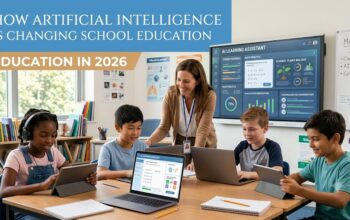
Artificial Intelligence in Education 🎓📚
Education is one of the areas where AI has created significant possibilities.
Students can use AI tools to receive explanations, practice concepts, generate study questions, organize notes, and explore unfamiliar subjects.
Teachers and educational organizations can explore AI for administrative tasks, personalized learning, content development, and feedback.
AI can potentially help learners receive more immediate assistance.
For example, a student struggling with a mathematical concept might ask for a simpler explanation or a new example.
However, education requires active learning.
If students rely on AI to complete every assignment, they may miss opportunities to develop reasoning, writing, research, and problem-solving skills.
AI should therefore complement learning rather than replace it.
Teachers and students also need to understand issues such as accuracy, attribution, privacy, and appropriate use.
The strongest educational applications of AI are likely to be those that encourage curiosity and deeper understanding. 🧠📖
AI and Healthcare Innovation 🏥🧬
Healthcare is another major area of AI research and application.
AI techniques can assist researchers and healthcare organizations with tasks such as analyzing medical images, identifying patterns in clinical information, supporting research, and improving operational processes.
Machine learning can process large datasets that may be difficult to analyze manually.
Computer vision can be used to examine certain types of medical images.
Natural language processing can help organize and analyze text-based information.
However, healthcare is a high-stakes field.
AI systems used in medical contexts require careful evaluation, appropriate oversight, validation, privacy protections, and consideration of clinical context.
An algorithm’s output should not automatically be treated as a medical conclusion.
The role of AI in healthcare is best understood as part of a larger system involving trained professionals, evidence, regulation, and patient needs. ❤️
AI in Business and Productivity 💼⚡
Organizations across industries are exploring AI to improve productivity and automate repetitive tasks.
Businesses may use AI for customer service, data analysis, document processing, forecasting, marketing research, software development, and workflow automation.
One major advantage of AI is its ability to process large amounts of information quickly.
For example, an organization may use AI to categorize documents or summarize large collections of text.
Generative AI can help employees create first drafts of reports, brainstorm ideas, or transform information into different formats.
However, productivity gains depend on implementation.
Organizations need to determine which tasks are appropriate for automation and where human review remains necessary.
Successful AI adoption therefore involves more than purchasing a tool. It can require process redesign, employee training, security planning, data governance, and ongoing evaluation. 📈
AI and Software Development 💻🤖
Artificial intelligence is changing the programming process itself.
AI coding assistants can help developers generate code, explain unfamiliar functions, suggest improvements, create test cases, and investigate errors.
This can reduce the amount of time spent on repetitive coding activities.
However, professional software development requires more than producing code.
Developers need to understand architecture, security, performance, maintainability, testing, and user requirements.
AI-generated code may contain errors or introduce vulnerabilities.
For this reason, developers should review generated code rather than accepting it automatically.
AI can become a powerful programming partner when developers understand both the tool and the underlying software principles.
The future of programming may involve a greater emphasis on designing systems, evaluating generated code, managing complexity, and communicating requirements clearly. 🚀
Natural Language Processing and the Power of Language 🗣️💻
Natural language processing, or NLP, focuses on enabling computers to work with human language.
NLP techniques support applications such as translation, text classification, sentiment analysis, search, summarization, conversational systems, and language generation.
Language is complex because words can have different meanings depending on context.
People use humor, metaphor, cultural references, incomplete sentences, and implied meanings.
Modern language models have demonstrated impressive capabilities in processing these patterns, but they can still misunderstand context or produce incorrect information.
Developers building language-based applications therefore need to think carefully about evaluation.
A system should be tested using representative examples and monitored after deployment.
NLP is an excellent example of how AI combines statistics, computation, linguistics, and large-scale data processing. 📚🤖
Computer Vision: Teaching Machines to Interpret Images 👁️📷
Computer vision focuses on enabling computers to analyze visual information.
Applications can include image classification, object detection, facial analysis, industrial inspection, medical imaging, autonomous systems, and visual search.
Modern computer-vision models can identify complex patterns in images.
For businesses, computer vision can support quality control and automated inspection.
In research, it can help scientists analyze images at scales that would be difficult to process manually.
Computer vision also raises important questions about privacy and responsible deployment.
Systems that analyze photographs or video can potentially process sensitive information.
Developers must therefore consider how visual data is collected, stored, processed, and protected.
Technical capability should always be considered alongside the context in which the technology is being used. 🔐📸
Robotics and Intelligent Machines 🤖⚙️
Robotics combines artificial intelligence with physical machines.
Robots can use sensors to perceive environments, algorithms to interpret information, and control systems to perform actions.
Applications include manufacturing, logistics, healthcare research, agriculture, exploration, and consumer products.
AI can make robots more adaptable by allowing them to recognize objects, navigate environments, and respond to changing conditions.
However, robotics presents challenges that purely digital AI systems may not encounter.
Physical environments are unpredictable.
Lighting can change. Objects can move unexpectedly. Sensors can produce imperfect information.
Robotic systems therefore need reliable perception, planning, control, and safety mechanisms.
The combination of AI and robotics is an exciting area because it connects digital intelligence with physical action. 🦾🌎
AI, Data Privacy, and Digital Security 🔐🛡️
AI systems often depend on data, making privacy an important consideration.
Users may provide personal information through applications without fully understanding how that information is processed.
Organizations developing AI systems should consider data minimization, appropriate security measures, access controls, retention policies, and transparency.
Cybersecurity is equally important.
AI applications can introduce new attack surfaces, particularly when they connect models with databases, APIs, external tools, or automated workflows.
Developers need to consider how systems behave when they receive unexpected or malicious input.
Security should be considered from the beginning of development rather than added after deployment.
Users also have a role to play by understanding privacy settings and avoiding unnecessary sharing of sensitive information with online services. 🔒
Responsible AI and Ethical Development ⚖️🌍
Artificial intelligence can create valuable opportunities, but responsible development is essential.
AI systems can reflect limitations in their training data or design.
Potential concerns include bias, inaccurate outputs, privacy risks, lack of transparency, and inappropriate automation.
Responsible AI involves asking questions before deployment.
What is the system supposed to accomplish?
Who might be affected?
What information does it use?
How will errors be detected?
When should a human review the output?
How will users understand the system’s limitations?
These questions help move AI development beyond technical performance alone.
A system can be fast and technically sophisticated while still being unsuitable for a particular application.
Responsible development therefore combines engineering, domain expertise, user research, security, and ethical consideration. 🤝
AI for Scientific Research 🔬🌌
Scientific research increasingly involves enormous quantities of information.
AI can help researchers analyze datasets, identify patterns, simulate complex systems, and generate hypotheses for further investigation.
In fields such as astronomy, biology, chemistry, climate science, and materials research, machine-learning techniques can support researchers working with complex datasets.
AI can also accelerate certain parts of the research workflow.
However, scientific conclusions still require careful validation.
A model’s prediction is not automatically a scientific discovery.
Researchers need to evaluate methods, reproduce results, examine limitations, and compare findings with established evidence.
AI therefore acts as a powerful research tool while scientific reasoning remains essential. 🧪
AI and Creativity 🎨🎬
AI is also changing creative workflows.
Writers can use AI for brainstorming.
Designers can explore visual concepts.
Musicians can experiment with new ideas.
Video creators can use AI-powered tools for editing, transcription, or production assistance.
These tools can reduce barriers to experimentation.
At the same time, creative work raises questions about originality, authorship, attribution, and the appropriate use of training data.
Creators need to understand the rules and expectations that apply to the tools they use.
AI can provide new creative possibilities, but human intention, judgment, experience, and cultural understanding remain important parts of creative expression. 🎨✨
The Importance of AI Literacy 📚🧠
As AI becomes more common, AI literacy is becoming increasingly valuable.
AI literacy does not mean everyone needs to become a machine-learning engineer.
Instead, people should understand basic concepts such as:
- what AI systems can and cannot do
- how machine learning uses data
- why AI can make mistakes
- how generated content should be evaluated
- what privacy considerations exist
- how automation can affect workflows
- when human judgment is necessary
AI literacy can help people become more informed technology users.
For students, it can support future careers.
For professionals, it can improve decision-making.
For businesses, it can help organizations evaluate AI opportunities more realistically.
Understanding technology makes it easier to use technology responsibly. 🌐
Starting an AI Learning Journey 🚀📖
People interested in artificial intelligence can begin without immediately studying advanced mathematics.
A practical starting point is learning basic programming.
Python is commonly used in AI and data science, so beginners can explore variables, functions, loops, lists, dictionaries, and basic object-oriented programming.
Next, learners can study data analysis and fundamental statistics.
After that, they can explore machine learning concepts and build small projects.
A simple learning path might look like:
Programming → Data → Statistics → Machine Learning → Deep Learning → Generative AI → AI Applications → Responsible AI.
Projects are particularly valuable.
Instead of studying only theoretical concepts, learners can create small applications and experiment with real datasets.
Each project can introduce new challenges and encourage deeper understanding. 💻✨
The Future of Artificial Intelligence 🔮🤖
The future of AI will likely involve continued advances in model capabilities, specialized systems, automation, robotics, and AI-assisted software development.
AI tools may become increasingly integrated into ordinary software applications.
Instead of opening a separate AI application, users may interact with intelligent capabilities directly inside productivity software, search systems, development environments, educational platforms, and professional tools.
This integration could make AI more useful but also make questions about transparency, privacy, reliability, and user control increasingly important.
Human skills will continue to matter.
Creativity, communication, critical thinking, domain expertise, ethical reasoning, and collaboration are difficult to reduce to simple automated tasks.
The future is therefore unlikely to be only about machines becoming more capable.
It will also be about how people choose to design, use, regulate, and integrate those capabilities into society. 🌎
Conclusion: Understanding AI in a Changing Digital World 🌟🤖
Artificial intelligence is one of the most significant technological developments of the modern digital era.
From machine learning and deep learning to generative AI, computer vision, natural language processing, robotics, and intelligent software, AI is influencing a wide range of industries and everyday experiences.
An AI blog can provide a valuable space for learning about these technologies while examining their practical applications and limitations.
The most important lesson is that AI should not be viewed simply as magic or as a replacement for human knowledge.
It is a collection of technologies developed through mathematics, computer science, data, engineering, research, and experimentation.
Understanding those foundations helps people use AI more effectively.
Whether someone is a student learning their first programming language, a professional exploring workplace automation, a developer building intelligent applications, or simply a technology enthusiast, there are countless opportunities to explore.
The future of AI will be shaped not only by algorithms and computing power but also by human choices.
Responsible development, thoughtful experimentation, strong digital literacy, and continuous learning can help ensure that artificial intelligence becomes a useful part of the evolving digital world. 🌍💻✨