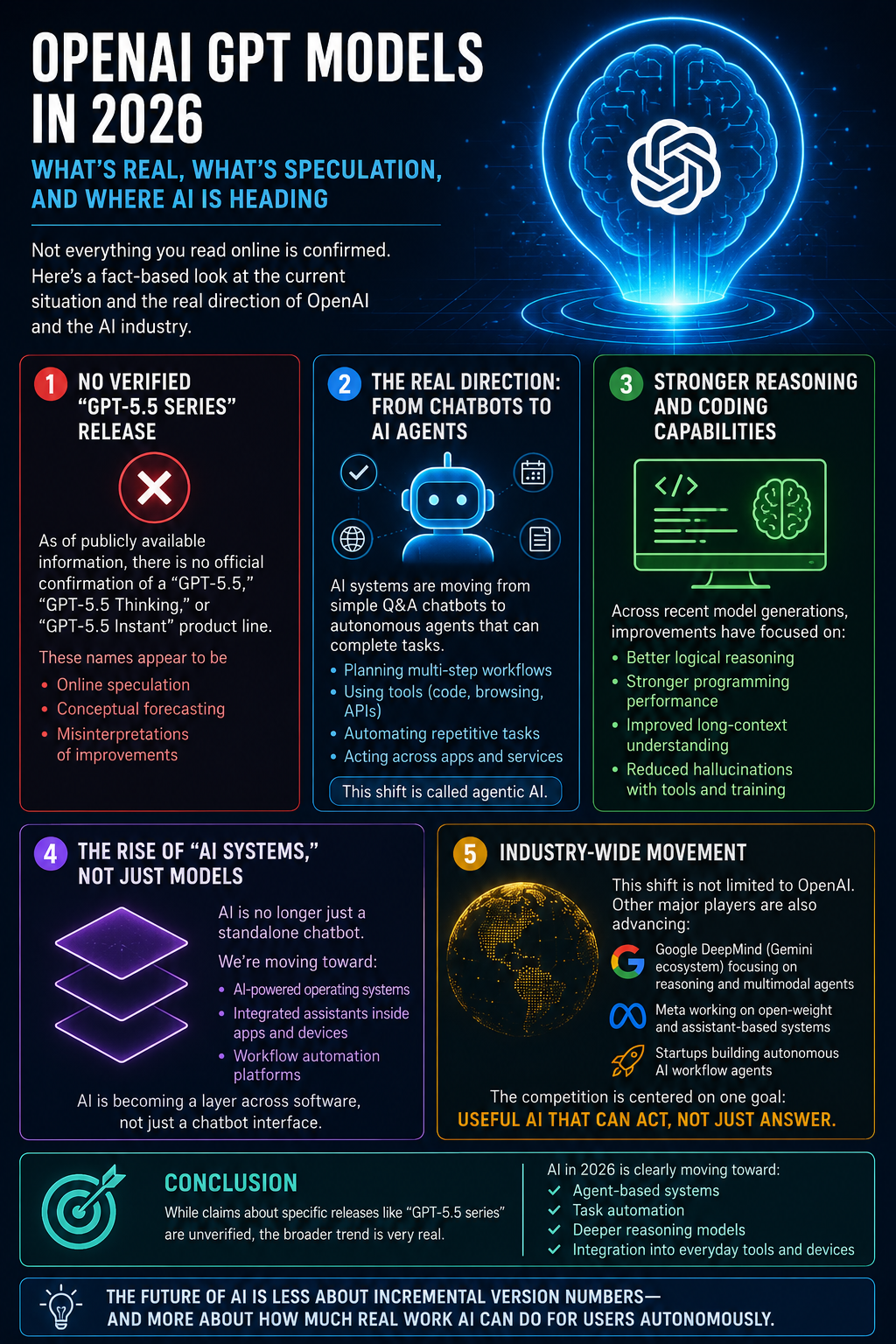
The AI landscape in 2026 is evolving rapidly, especially around large language models and autonomous “agent-like” systems. However, not all claims circulating online about new model releases are confirmed. One such example is the rumored “GPT-5.5 series,” which has not been officially verified.
Below is a clear, fact-based breakdown of where things stand and the broader direction of OpenAI and the AI industry.
1. No Verified “GPT-5.5 Series” Release
As of publicly available and verified information, there is no official confirmation of a “GPT-5.5,” “GPT-5.5 Thinking,” or “GPT-5.5 Instant” product line.
These names appear to be part of:
- Online speculation
- Conceptual forecasting of future model tiers
- Misinterpretations of ongoing model improvements
While OpenAI continues to advance its models, specific version naming like “5.5” has not been officially introduced.
2. The Real Direction: From Chatbots to AI Agents
The most important confirmed trend is not a version number—it is a shift in capability.
Modern AI systems are moving from:
- Simple Q&A chatbots
→ to - Autonomous AI agents that can complete tasks
This includes abilities like:
- Planning multi-step workflows
- Using tools (code execution, browsing, APIs)
- Automating repetitive digital tasks
- Acting across apps and services
This shift is often referred to as agentic AI.
3. Stronger Reasoning and Coding Capabilities
Across recent model generations, improvements have focused on:
- Better logical reasoning
- Stronger programming performance
- Improved long-context understanding (handling large documents or conversations)
- Reduced hallucination rates through better training and tool use
Instead of just responding faster, the focus is now on thinking more reliably and acting more accurately.
4. The Rise of “AI Systems,” Not Just Models
Another key change is that AI is no longer being developed as standalone chat models.
Instead, companies are building:
- AI-powered operating systems
- Integrated assistants inside apps and devices
- Workflow automation platforms
This means AI is becoming a layer across software, not just a chatbot interface.
5. Industry-Wide Movement (Not Just One Company)
The shift is not limited to OpenAI.
Other major players are also advancing similar directions:
- Google DeepMind (Gemini ecosystem) focusing on reasoning and multimodal agents
- Meta working on open-weight and assistant-based systems
- Multiple startups building autonomous AI workflow agents
The competition is centered on one goal: useful AI that can act, not just answer.
Conclusion
While claims about specific releases like “GPT-5.5 series” are currently unverified, the broader trend is very real.
AI development in 2026 is clearly moving toward:
- Agent-based systems
- Task automation
- Deeper reasoning models
- Integration into everyday tools and devices
The future of AI is less about incremental version numbers—and more about how much real work AI can do for users autonomously.