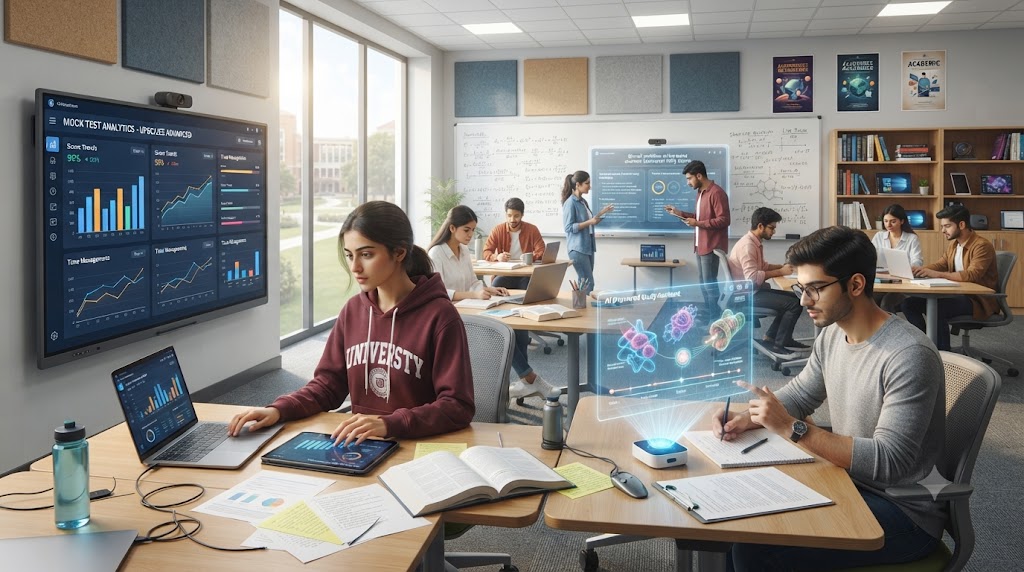
The world of competitive examinations is changing rapidly. Whether students are preparing for UPSC, SSC, Banking, Railway, JEE, NEET, CAT, GATE, CUET, OPSC, or state government examinations, technology has become an essential part of the learning process. The rise of Artificial Intelligence (AI) has transformed how students study, practice questions, manage time, and analyze their performance.
Unlike traditional learning methods that relied mainly on books and coaching institutes, today’s aspirants have access to AI-powered learning platforms, adaptive mock tests, intelligent study planners, virtual tutors, and personalized feedback systems. These innovations are helping students prepare more efficiently while saving valuable time.
However, technology is not a replacement for hard work. Instead, it acts as a smart assistant that helps students focus on the right topics, identify weaknesses, and build confidence before the examination.
This article explores how AI and modern technology are revolutionizing competitive exam preparation and how students can use these tools effectively.
Why Competitive Exam Preparation Is Changing
Competitive exams have become more challenging over the years. Millions of candidates compete for limited seats, making smart preparation more important than ever.
Students today face several challenges:
- Vast syllabus
- Limited preparation time
- Frequent changes in exam patterns
- Increasing competition
- Difficulty in identifying weak areas
- Maintaining consistency
AI-powered educational technologies address many of these problems by providing personalized learning experiences instead of the traditional one-size-fits-all approach.
How Artificial Intelligence Is Transforming Learning
1. Personalized Study Plans
Every student learns differently.
Some students struggle with mathematics, while others find reasoning or English difficult.
AI platforms analyze:
- Previous test scores
- Time spent on each topic
- Accuracy rate
- Learning speed
- Revision history
Based on this data, AI creates customized study schedules that focus more on weak subjects while maintaining strengths.
Instead of wasting hours revising already mastered topics, students spend more time improving areas that need attention.
2. AI Tutors Available 24/7
One of the biggest advantages of AI is instant doubt-solving.
Instead of waiting for coaching classes, students can:
- Ask conceptual questions
- Request simplified explanations
- Generate examples
- Understand formulas
- Practice similar problems
AI tutors can explain concepts in multiple ways until students understand them clearly.
This makes learning flexible and convenient.
3. Smart Mock Tests
Mock tests have always been essential for exam preparation.
Modern AI-based mock tests go beyond simply showing scores.
They analyze:
- Accuracy percentage
- Speed
- Question difficulty
- Topic-wise performance
- Negative marking trends
- Time management
Students receive detailed reports showing exactly where improvements are needed.
4. Adaptive Learning
Traditional question banks provide the same questions to every student.
AI changes this completely.
If a student answers correctly, the system gradually increases the difficulty level.
If mistakes occur repeatedly, AI provides easier questions and additional explanations before increasing difficulty again.
This adaptive learning improves conceptual understanding much faster.
5. Instant Feedback
Previously, students waited days or weeks for teachers to evaluate tests.
Today AI provides feedback within seconds.
Students immediately learn:
- Why an answer is incorrect
- Better solving techniques
- Alternative methods
- Important concepts to revise
Instant feedback helps reduce repeated mistakes.
Time Management with AI
Time management is one of the biggest factors in competitive exam success.
AI tools help students by:
- Creating daily schedules
- Sending study reminders
- Tracking productivity
- Measuring study hours
- Identifying distractions
- Planning revision sessions
Students can visualize their progress using dashboards and performance charts.
This keeps motivation high.
AI for Revision
Revision is often more important than learning new topics.
AI assists revision through:
Smart Flashcards
Automatically generated flashcards help students memorize formulas, facts, and definitions.
Spaced Repetition
AI schedules revision sessions exactly when students are about to forget information.
This scientifically improves long-term memory.
Quiz Generation
Students can instantly generate quizzes on:
- History
- Geography
- Science
- Current Affairs
- Mathematics
- Polity
- Economics
Regular quizzes improve retention.
AI for Current Affairs
Competitive exams increasingly emphasize current affairs.
AI-powered news summarization tools help students:
- Read important headlines quickly
- Generate concise notes
- Understand government schemes
- Track international events
- Revise monthly current affairs
Instead of reading dozens of newspapers, students can focus on exam-relevant updates.
Voice-Based Learning
Modern AI assistants support voice interaction.
Students can:
- Ask questions verbally
- Listen to explanations
- Revise while traveling
- Practice pronunciation
- Improve spoken English
Voice learning makes study sessions more flexible.
AI-Based Performance Analytics
One of AI’s strongest capabilities is data analysis.
Performance dashboards display:
| Metric | Benefit |
|---|---|
| Accuracy | Measures correctness |
| Speed | Tracks solving time |
| Weak Topics | Identifies improvement areas |
| Strong Topics | Maintains confidence |
| Daily Progress | Encourages consistency |
| Mock Test Ranking | Measures competitiveness |
These insights help students study smarter.
Benefits for Rural Students
Technology has reduced educational inequality.
Students in remote areas can now access:
- Online lectures
- AI tutors
- Digital libraries
- Mock tests
- Interactive quizzes
- Recorded classes
A smartphone with internet access can provide learning resources comparable to those available in major cities.
AI and Language Learning
Many competitive exams require proficiency in English or regional languages.
AI tools assist students by:
- Correcting grammar
- Improving vocabulary
- Explaining comprehension passages
- Practicing essay writing
- Enhancing translation skills
Students receive immediate corrections and suggestions.
AI for Writing Practice
Descriptive examinations require strong writing skills.
AI can evaluate:
- Grammar
- Sentence structure
- Vocabulary
- Clarity
- Readability
- Organization
Students can improve essays and answers through regular feedback.
Interview Preparation
Several examinations include personality tests or interviews.
AI helps candidates by:
- Conducting mock interviews
- Asking likely questions
- Evaluating confidence
- Improving communication
- Suggesting better responses
Repeated practice reduces interview anxiety.
Maintaining Motivation
Preparation often lasts several months or years.
AI-based study apps encourage consistency through:
- Daily goals
- Progress charts
- Achievement badges
- Streak tracking
- Personalized encouragement
These features make long-term preparation easier.
Limitations of AI
Despite its advantages, AI has certain limitations.
Students should remember:
- AI may occasionally provide incorrect information.
- Human teachers offer emotional support and mentorship.
- Practical experience still matters.
- Self-discipline cannot be replaced.
- Internet dependency can become distracting.
AI should be viewed as a learning assistant rather than a substitute for teachers.
Best Practices for Students
To make the most of AI tools:
- Create a realistic study timetable.
- Use AI for doubt-solving rather than shortcuts.
- Take regular mock tests.
- Revise consistently.
- Limit unnecessary screen time.
- Verify important facts from reliable sources.
- Continue reading standard textbooks.
- Practice writing answers manually.
- Analyze every mock test carefully.
- Stay physically active and maintain a healthy routine.
Future of AI in Competitive Exams
The next generation of educational technology may include:
- AI-powered virtual classrooms
- Real-time adaptive examinations
- Personalized career guidance
- Advanced speech evaluation
- Immersive VR learning environments
- Predictive performance analysis
- Multilingual AI tutors
- Intelligent revision assistants
These innovations are expected to make learning more personalized, accessible, and effective.
Conclusion
Artificial Intelligence is reshaping competitive exam preparation by making learning smarter, more personalized, and more efficient. From adaptive study plans and intelligent mock tests to instant feedback and AI tutors, technology empowers students to identify weaknesses, strengthen concepts, and optimize their preparation strategies. While AI offers remarkable support, success still depends on discipline, consistent practice, critical thinking, and perseverance. Students who combine traditional study methods with modern AI-powered tools will be better equipped to face the challenges of today’s competitive examinations and the opportunities of tomorrow’s digital learning landscape.