Introduction
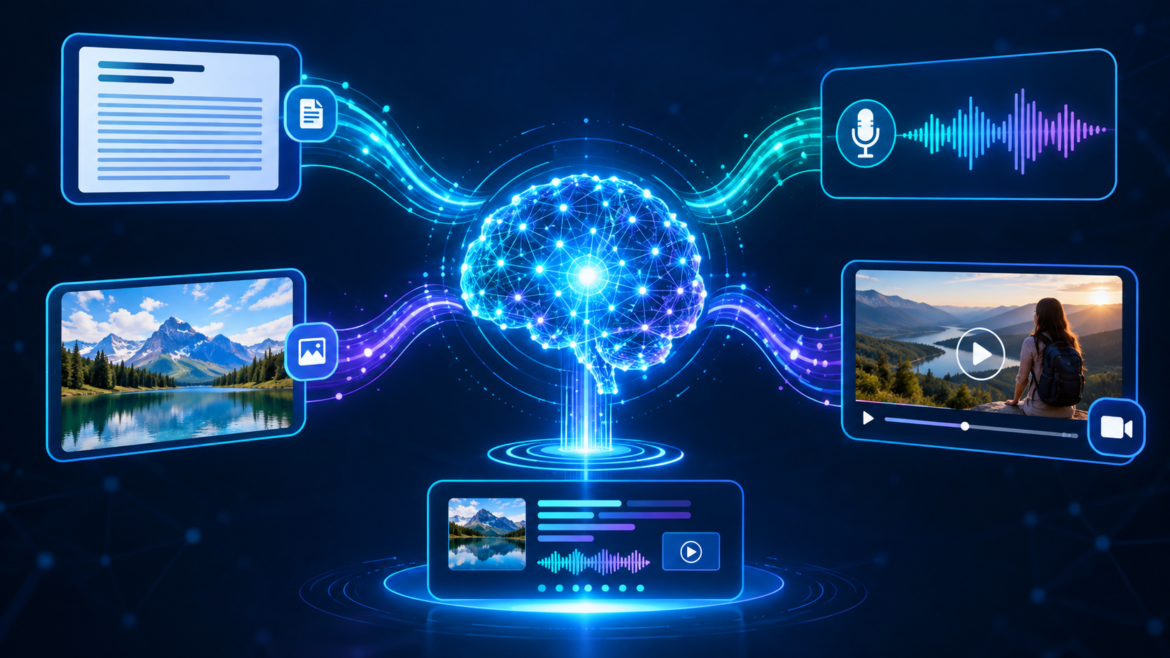
Artificial Intelligence (AI) is evolving beyond systems that understand only text or perform a single task. Multimodal AI is an advanced field of artificial intelligence that enables machines to process, understand, and connect information from multiple data types, including text, images, audio, and video.
Humans naturally combine different forms of information to understand the world. For example, when watching a video, we interpret spoken words, facial expressions, background sounds, and visual movements simultaneously. Multimodal AI aims to develop similar capabilities in machines, allowing them to build a richer understanding of complex situations.
This technology is becoming increasingly important in healthcare, education, robotics, autonomous systems, customer service, and scientific research. By integrating different data sources, multimodal models can deliver more contextual, interactive, and useful results than systems that rely on only one type of input.
🧠 What Is Multimodal AI?
Multimodal AI refers to AI systems that can work with two or more types of data and learn relationships between them. These systems may accept a written question alongside an image, analyze spoken instructions while examining a video, or combine sensor readings with visual information to make a decision.
For example, a user could upload a photograph of a damaged machine and ask, “What might have caused this problem?” A multimodal AI system could analyze the image, interpret the question, identify visible damage, and generate a text-based explanation.
The key innovation is not simply processing different data types separately. It is integrating information across modalities so that the system can use relevant evidence from each source to answer a question or complete a task.
Common modalities include:
- Text: Documents, questions, reports, captions, and written instructions.
- Images: Photographs, diagrams, medical scans, charts, and screenshots.
- Audio: Speech, conversations, environmental sounds, and music.
- Video: Moving images, events, actions, and temporal sequences.
- Sensor data: Measurements from cameras, microphones, wearable devices, and industrial equipment.
Multimodal AI can combine several of these inputs to produce text, summaries, predictions, classifications, or other outputs.


🔍 How Does Multimodal AI Work?
Multimodal AI combines several stages of data processing, representation learning, alignment, fusion, and reasoning. The precise architecture varies depending on the model and its intended application.
1. Data Collection and Preprocessing
The first stage involves gathering information from different sources. Text may come from documents, images from cameras, audio from microphones, and video from recorded or live streams.
Each data type requires appropriate preprocessing. Images may be resized, audio may be converted into suitable representations, video may be sampled into frames, and text may be divided into tokens. The goal is to prepare the data so that the model can process it effectively.
Data quality matters significantly. Blurry images, background noise, incomplete transcripts, and poorly synchronized video can reduce the reliability of the final output.
2. Modality-Specific Encoders
Many multimodal systems use specialized components called encoders to transform raw inputs into numerical representations that AI models can process.
A vision encoder extracts visual features such as objects, shapes, colors, and spatial relationships. A text encoder represents words and their meanings. Audio encoders process speech, sound patterns, and acoustic information, while video systems capture both visual content and changes over time.
These representations allow the model to work with information that originally appeared in very different formats.
3. Cross-Modal Alignment
Alignment is the process of connecting related information across different modalities.
For example, a video may show a person opening a door while the audio contains the sound of a door handle turning. A well-aligned model can connect the visual action with the corresponding sound and any accompanying narration.
Training methods can teach models to associate image regions with descriptions, spoken words with transcripts, and video frames with their timestamps. Contrastive learning, attention mechanisms, and other alignment techniques can help establish these relationships.
4. Multimodal Fusion
Fusion combines information from different modalities into a representation that supports a shared task.
Researchers commonly distinguish three broad approaches:
- Early fusion: Inputs or their representations are combined near the beginning of the processing pipeline.
- Intermediate fusion: Features are integrated within the model, often using attention or shared neural layers.
- Late fusion: Separate models process each modality first, and their outputs are combined to make a final prediction.
Each approach has trade-offs involving computational cost, flexibility, accuracy, and the degree of interaction between modalities. Recent surveys examine these techniques alongside challenges such as alignment errors, data quality, and differences between modality representations.
5. Reasoning and Output Generation
After information is integrated, the model uses the resulting representation to answer questions, summarize events, classify content, or generate an appropriate response.
Depending on the system, the output could be a written explanation, spoken answer, caption, video summary, or structured prediction.
For instance, when analyzing a recorded lecture, a multimodal model might combine the lecturer’s speech, presentation slides, and video timestamps to create a searchable summary of the most important concepts.
🖼️ The Four Major Modalities in Multimodal AI

1. Text Processing
Text provides linguistic meaning and context. Multimodal systems can interpret questions, summarize documents, connect descriptions to visual objects, and follow written instructions. Text often serves as the interface through which users communicate their goals to the AI.

2. Image Understanding
Image processing helps AI recognize objects, interpret diagrams, examine scenes, and extract information from photographs. When connected with text, it enables visual question answering, image captioning, document analysis, and image-based search.

3. Audio Understanding
Audio models process spoken language and other sounds. They can support transcription, speech recognition, speaker-related analysis, and sound-event detection. Integrated systems can use audio alongside visual information to understand spoken instructions or events in a recording.

4. Video Understanding
Video introduces a temporal dimension: the model must consider how a scene changes over time. This may involve identifying actions, tracking objects, connecting dialogue with events, and summarizing long recordings. Combining video with audio makes it possible to analyze both what happens and what can be heard.
🚀 Why Is Multimodal AI Important?
Traditional AI systems often specialize in one kind of input. A text-only model may describe a concept but cannot directly inspect an image unless it has visual capabilities. A vision-only system may identify an object without understanding the user’s broader question.
Multimodal AI addresses these limitations by combining complementary information. A diagram can clarify a written explanation, speech can add context to a video, and text can guide an image-analysis task.
This integration can make AI systems more adaptable to real-world problems, where information rarely arrives in a single, clean format. However, combining modalities does not automatically guarantee better results. The model must learn which information is relevant, resolve conflicts between sources, and avoid relying on misleading signals.
🏥 Real-World Applications of Multimodal AI


1. Healthcare and Medical Research
Healthcare is one of the most promising applications of multimodal AI. Medical professionals work with many forms of information, including patient histories, laboratory results, radiology images, audio notes, and clinical observations.
A multimodal system could help organize these sources, summarize a patient’s medical history, identify relevant features in a scan, and connect them with the written clinical context. Researchers can also investigate models that combine medical imaging with clinical records to support more comprehensive analysis.
For example, a research system might examine a chest image alongside a patient’s reported symptoms and relevant test results. Rather than relying on the image alone, it could help a qualified clinician review the information together.
However, medical AI must be evaluated carefully. An incorrect interpretation can have serious consequences, and models may perform differently across hospitals, patient populations, imaging equipment, and data formats. Multimodal AI should support qualified medical professionals rather than replace clinical judgment.
2. Education and Personalized Learning


Multimodal AI can make education more interactive by allowing students to learn through text, images, audio, and video.
A student could upload a photograph of a mathematics problem and ask for a step-by-step explanation. Another learner could record a spoken question, while the AI uses a diagram or animation to explain the answer.
Teachers may also use multimodal systems to summarize recorded lessons, generate quizzes from presentations, explain scientific diagrams, and convert written content into audio-friendly learning materials.
These capabilities could benefit learners who prefer visual explanations, have difficulty reading lengthy documents, or need additional language support. Nevertheless, educational systems must encourage students to understand the reasoning behind an answer instead of simply copying the output.
3. Robotics and Autonomous Systems
Robots need to interpret their surroundings before taking action. They may rely on cameras, microphones, depth sensors, tactile sensors, and written or spoken instructions.
Multimodal AI can help connect these inputs. A household robot, for example, might interpret a spoken instruction to bring a cup, use its camera to locate the cup, and use spatial information to navigate toward it.
Similarly, industrial robots can combine visual inspection with machine-sensor readings to detect possible equipment problems. Autonomous systems may integrate cameras and other sensors to improve environmental understanding.
The central challenge is reliability. A robot must distinguish between uncertain observations and trustworthy information, especially when operating around people. Real-time processing, safe movement, and predictable behavior remain essential.
4. Business Intelligence and Customer Service
Businesses generate large amounts of text, audio, image, and video data. Multimodal AI can help connect these sources to provide more useful analysis.
For example, a customer-support system might examine a customer’s written complaint, a photograph of a damaged product, and a recorded explanation. The system could then produce a structured summary for a human support agent.
Retailers could use product photographs alongside written descriptions to improve search results. Manufacturers might combine visual inspection footage with maintenance reports. Marketing teams could analyze video advertisements, spoken dialogue, and audience feedback together.
These applications can reduce repetitive work and improve information retrieval. Businesses should still establish rules for data access, accuracy checks, customer consent, and the handling of confidential information.
5. Media, Entertainment, and Content Creation


Multimodal AI is changing the way people create and manage digital media.
Content creators can use AI tools to generate captions, summarize videos, locate specific scenes, transcribe interviews, and connect spoken words with visual events. Some generative systems can also create images, audio, or video from text instructions or combinations of inputs.
For example, a creator working on a travel video could request a transcript, identify scenes featuring a particular landmark, and generate a draft description for publication.
These tools can improve accessibility and speed up production workflows. However, synthetic media also creates risks, including unauthorized impersonation, misleading edits, copyright disputes, and fabricated evidence. Human review and clear disclosure are important whenever generated content could be mistaken for authentic recordings.
6. Accessibility and Assistive Technology
Multimodal AI can help make digital information more accessible to people with different needs.
A system could describe a photograph aloud, convert speech into captions, explain the contents of a document, or answer spoken questions about a visual scene. Combining audio and image information may help users interact with their surroundings more independently.
In education, multimodal tools can provide alternative ways to access learning materials. In workplaces, they can help people navigate documents, recorded meetings, and complex visual interfaces.
These benefits depend on good design. Accessibility systems must account for varied communication preferences, privacy, language differences, and the consequences of incorrect descriptions.
7. Scientific Research and Environmental Monitoring
Scientific discoveries frequently depend on connecting different types of evidence. Researchers may work with satellite images, sensor readings, written reports, recorded observations, and time-series measurements.
Multimodal AI could help analyze these sources together. Environmental researchers might combine satellite imagery with weather measurements and written field reports to investigate changes in land cover. Biologists could explore relationships between visual observations and recorded environmental conditions.
In laboratories, multimodal models may help researchers search large collections of documents, diagrams, experimental images, and audio notes.
Such systems can accelerate exploration and identify patterns worth investigating, but their conclusions still require validation using appropriate scientific methods.
⚙️ Key Technologies Behind Multimodal AI
Multimodal AI is not one specific algorithm. It is a collection of techniques for representing, connecting, and learning from different data types.
Transformer Architectures and Attention
Transformers use attention mechanisms to model relationships between elements in a sequence. In multimodal systems, attention can help the model determine which words, image regions, audio segments, or video frames are relevant to the current task.
Cross-attention can connect one modality to another. For example, a text query can guide attention toward relevant areas in an image.
Transformer-based architectures are widely used in contemporary multimodal research, although alternative architectures and specialized components remain useful for particular tasks.
Contrastive Learning
Contrastive learning trains models to place related examples closer together in a shared representation space and unrelated examples farther apart.
A model might learn that an image of a dog corresponds to a caption describing a dog. Once trained, the model can use these representations for image-text retrieval, matching, or classification.
The approach is useful because it can learn relationships from large collections of paired data. However, performance depends on the quality and diversity of the training examples.
Vision-Language Models
Vision-language models connect visual information with natural language. They can perform tasks such as image captioning, visual question answering, document understanding, and text-guided image retrieval.
Some larger multimodal language models also support audio and video inputs, allowing users to interact with them through several forms of information.
The ability to accept multiple inputs does not mean every model understands every modality equally well. Its actual capabilities depend on the architecture, training process, available context, and evaluation results.
Multimodal Large Language Models
Multimodal large language models, often abbreviated as MLLMs, extend language-modeling approaches to additional data types.
Depending on the design, a model may use a visual encoder, audio encoder, or video-processing component connected to a language model. Other systems use more unified representations to process multiple modalities.
Research published in 2026 continues to examine the architecture, training methods, applications, and reliability challenges of these systems.
Generative Models
Generative AI can produce new content based on learned patterns. In multimodal settings, a model might generate an image from a text description, produce speech from text, or create a video using text and visual references.
Some systems support transformations across modalities, such as converting speech into a transcript or turning a video into a written summary.
Generation introduces its own evaluation challenges. A result may be visually convincing while containing incorrect details, or an audio output may sound natural while misrepresenting the intended message.
🔬 Current Research Directions in Multimodal AI
Multimodal research is moving beyond simply accepting multiple input formats. Researchers increasingly investigate whether models can reason across modalities, remain reliable when information is incomplete, and operate efficiently in real-world environments.
A 2026 survey of multimodal alignment and fusion reviews more than 260 relevant studies and discusses structural approaches, including data-level, feature-level, and output-level fusion. It also highlights unresolved problems involving cross-modal alignment, computational demands, data quality, and differences between modality representations.
Several research directions are particularly important.
Cross-modal reasoning: Researchers are developing methods that require models to connect evidence across modalities rather than solve each task independently. An example is determining whether an action described in a transcript matches what is actually visible in a video.
Long-video understanding: A long recording can contain thousands of frames, making it difficult to preserve context while keeping processing costs manageable. Research explores efficient frame selection, temporal representations, memory mechanisms, and retrieval methods.
Real-time audio-video interaction: Models that process synchronized audio and video can potentially respond to ongoing conversations, demonstrations, and environmental events. Low latency and accurate synchronization are major technical requirements.
Efficient multimodal learning: Processing several modalities can demand substantial computing power and training data. Researchers investigate smaller models, parameter-efficient fine-tuning, compression, selective processing, and more efficient attention mechanisms.
Robustness and trustworthy reasoning: Models need to recognize missing or contradictory information instead of producing a confident but unsupported answer. Researchers are exploring uncertainty estimation, grounding techniques, better evaluation methods, and strategies for identifying unreliable inputs.
Multilingual multimodal learning: A system should ideally connect images, speech, and text across different languages. This is especially important for languages and communities that are underrepresented in large training datasets.
Embodied AI: Multimodal systems are increasingly relevant to agents and robots that perceive their environments and act within them. Such systems need to connect visual observations, instructions, spatial information, and feedback from their actions.
These directions demonstrate that multimodal AI is not only about combining more data. It is about making the relationships between data more meaningful, efficient, and dependable.
⚠️ Major Challenges in Developing Multimodal AI
Despite its potential, multimodal AI faces several technical and ethical challenges. Building a system that accepts text, images, audio, and video is relatively different from building one that reliably understands the relationships between all four.
1. Data Quality and Availability
High-quality multimodal training data can be difficult to collect. Images may have inaccurate captions, audio recordings may contain background noise, and video transcripts may not match the events shown on screen.
Data may also be incomplete or unevenly distributed across languages, locations, and demographic groups. If a model learns from biased or poorly labeled datasets, its predictions may reproduce those weaknesses.
Developers need carefully curated datasets, appropriate quality checks, and evaluation procedures that reveal where the model performs poorly.
2. Cross-Modal Misalignment
Different modalities may describe the same event in inconsistent ways. A transcript might mention an object that is never shown, or a sound might occur before the corresponding action appears in a recording.
Models must learn to handle these mismatches without assuming that all available evidence is equally trustworthy.
Research into alignment and fusion treats this as a central challenge because inaccurate connections between modalities can undermine the entire prediction process.
3. High Computational Costs
Processing a document, a high-resolution image, several minutes of audio, and a long video requires substantially more computation than processing a short text prompt alone.
Video is particularly demanding because it contains many frames, each of which may contribute useful information. Real-time applications also need to process inputs quickly enough to remain interactive.
Potential solutions include efficient encoders, selective frame sampling, quantization, caching, model compression, and routing tasks to smaller specialized models when appropriate.
4. Hallucinations and Incorrect Conclusions
A multimodal model can produce an answer that sounds convincing but is not supported by its inputs. It may misidentify an object, misunderstand a speaker, invent details about a scene, or combine unrelated observations.
Using multiple modalities does not automatically eliminate hallucinations. Different inputs may even reinforce the same incorrect interpretation.
Developers can reduce these risks through evidence-grounded generation, confidence calibration, source verification, targeted testing, and human review for high-impact decisions.
5. Privacy, Security, and Ethical Concerns
Images, audio, and video can contain faces, private conversations, location details, and other sensitive information. Combining these sources may reveal more about individuals than any single source would reveal independently.
Multimodal AI can also be misused to create deceptive media or infer personal characteristics in inappropriate ways.
Responsible development requires data minimization, access controls, informed consent where applicable, secure storage, clear retention policies, and safeguards against unauthorized impersonation. Systems should also be evaluated for bias and discriminatory outcomes.
🛠️ How to Develop a Multimodal AI System
Building a practical multimodal AI application requires a clearly defined objective and a structured development process.
Step 1: Define the task
Choose a specific problem, such as answering questions about images, summarizing lectures, or identifying events in recorded videos. Define measurable success criteria before selecting a model.
Step 2: Collect and prepare data
Gather relevant examples with appropriate permissions. Clean the text, check image quality, process audio, and align video frames with timestamps and transcripts where needed.
Step 3: Choose the architecture
Decide whether to use an existing multimodal foundation model, connect specialized models, or train a custom architecture. The choice depends on the task, budget, latency, and available data.
Step 4: Align and integrate modalities
Connect relevant information through shared representations, attention mechanisms, retrieval, or other fusion methods. Preserve important details such as timestamps and relationships between objects and descriptions.
Step 5: Evaluate the system
Test individual modalities and combined inputs. Measure task accuracy, grounding, latency, robustness, and performance when information is missing or contradictory.
Step 6: Deploy responsibly
Add privacy protections, monitoring, fallback behavior, and human review where necessary. Continue evaluating the model as real-world data and user needs change.
Example: Building a Video Lecture Summarizer
Imagine developing an AI application that converts recorded lectures into searchable study notes.
The system could transcribe the lecturer’s speech, extract important video frames, read text from presentation slides, and combine the results into a structured summary.
It could then generate chapter headings, identify key definitions, create revision questions, and attach timestamps to important explanations.
To ensure quality, developers should compare generated summaries against the original recording, verify timestamps, check factual accuracy, and test lectures with different accents, presentation styles, and audio conditions.
This example illustrates how multimodal AI can turn several separate data sources into one useful learning experience.
🔮 The Future of Multimodal AI


The future of multimodal AI will likely involve systems that interact more naturally with people and their environments. Instead of requiring users to convert everything into written prompts, AI applications will increasingly support combinations of spoken instructions, visual references, documents, and recorded events where their capabilities allow.
More Natural Human-AI Interaction
People may be able to speak while sharing a screen, point to objects in a visual scene, and ask follow-up questions without repeatedly explaining the context.
Such systems could make digital assistants more useful for learning, workplace collaboration, accessibility, and everyday problem-solving. Their effectiveness will depend on their ability to follow context, recognize ambiguity, and respond appropriately.
AI Agents With Multimodal Perception
Multimodal perception can also improve AI agents that plan and carry out tasks. An agent could inspect a document, interpret a chart, listen to a spoken instruction, and use relevant information to determine its next step.
In robotics, similar capabilities may help machines understand instructions and navigate physical environments. However, perception alone does not guarantee safe action. Reliable planning, feedback, access controls, and safety constraints remain necessary.
Personalized and Adaptive Learning
Future educational applications may combine students’ spoken questions, written answers, diagrams, and learning materials to provide explanations suited to different learning needs.
Personalization must be implemented carefully, with appropriate privacy protections and opportunities for students to challenge incorrect feedback.
Smarter Scientific Discovery
Multimodal models may help researchers connect experimental images, scientific publications, sensor readings, and recorded observations. This could make it easier to explore large research collections and identify relationships that deserve further investigation.
Such models should be treated as research assistants rather than unquestionable sources of scientific truth. Experimental validation and reproducible methods will remain essential.
More Efficient and Trustworthy Models
An important future goal is to develop models that deliver strong multimodal performance with less computation and greater reliability.
Research may increasingly focus on efficient architectures, better data selection, improved uncertainty estimation, interpretable evidence connections, and rigorous evaluation under real-world conditions. Progress in these areas will help determine whether multimodal AI becomes dependable infrastructure rather than merely an impressive demonstration.
📌 Conclusion
Multimodal AI represents an important development in artificial intelligence because it enables systems to process and connect text, images, audio, and video. By integrating different types of evidence, these models can support richer interactions, more flexible applications, and new approaches to complex problems.
Its applications span healthcare, education, robotics, business intelligence, media production, accessibility, and scientific research. At the same time, challenges involving data quality, cross-modal alignment, computational costs, hallucinations, privacy, and bias must be addressed.
The next stage of multimodal AI development will depend not only on increasing model capabilities but also on making those capabilities efficient, transparent, and trustworthy. With careful research and responsible implementation, multimodal systems can become valuable tools for solving real-world problems and improving how people interact with technology.