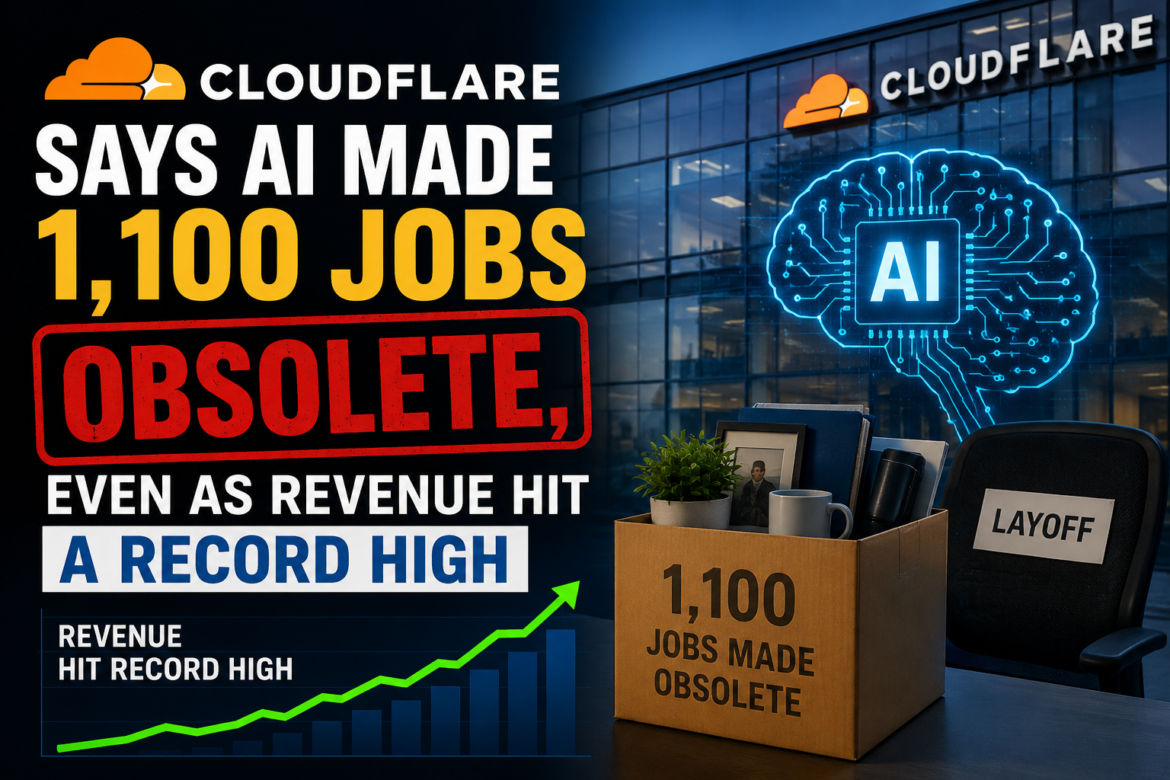
The rapid rise of artificial intelligence is transforming the global workforce, and technology companies are among the first to feel the impact. Recently, Cloudflare revealed that advances in AI and automation have significantly changed the way the company operates. According to reports, the company stated that AI-driven efficiency has made nearly 1,100 jobs obsolete, even while the company achieved record-breaking revenue growth.
The announcement highlights a growing trend across the tech industry: companies are increasingly relying on artificial intelligence to streamline operations, reduce repetitive work, and improve productivity. While this creates opportunities for innovation and higher profits, it also raises concerns about employment stability and the future of human labor.
How AI Is Reshaping the Workplace

Artificial intelligence has evolved far beyond simple automation tools. Modern AI systems can now perform tasks such as customer support, data analysis, software testing, cybersecurity monitoring, and content generation with remarkable speed and accuracy.
For companies like Cloudflare, AI can automate many operational processes that once required large teams of employees. Tasks that previously took hours can now be completed in minutes using machine learning systems and intelligent software.
This shift allows businesses to:
- Reduce operational costs
- Increase efficiency
- Improve service speed
- Scale operations faster
- Analyze large amounts of data instantly
As a result, companies can generate higher revenue while operating with fewer employees.
Record Revenue Despite Workforce Changes
Despite concerns about job displacement, Cloudflare reported strong financial performance and record-high revenue. This reflects how AI technologies can improve profitability by optimizing workflows and minimizing overhead costs.
Investors often view AI adoption positively because it can increase productivity and long-term growth potential. Companies that successfully integrate AI into their operations may gain a competitive advantage in rapidly evolving markets.
However, the situation also raises ethical and social questions. While businesses benefit financially, workers affected by automation may face unemployment or the need to retrain for new careers.
The Growing Debate Around AI and Employment
The impact of AI on jobs has become one of the most debated topics in the modern economy. Supporters argue that AI creates new industries, improves innovation, and removes repetitive tasks, allowing humans to focus on creative and strategic work.
Critics, however, warn that automation could replace millions of jobs across industries including:
- Technology
- Customer service
- Manufacturing
- Finance
- Transportation
- Media and marketing
The statement from Cloudflare demonstrates how quickly these changes are already happening.
Experts believe future workers will need stronger digital skills, adaptability, and continuous learning to remain competitive in an AI-driven economy.
The Future of AI in Business
AI adoption is expected to accelerate in the coming years as companies continue searching for ways to improve efficiency and reduce costs. Businesses worldwide are investing heavily in machine learning, automation platforms, and generative AI technologies.
At the same time, governments and educational institutions may need to develop new strategies to help workers transition into emerging careers. Upskilling programs, digital education, and AI literacy could become essential parts of the future workforce.
The case of Cloudflare serves as both a warning and an example of how artificial intelligence is reshaping the global economy. While AI can drive extraordinary growth and innovation, it also challenges traditional employment structures and forces society to rethink the relationship between technology and human work.
Conclusion
The announcement that AI made 1,100 jobs obsolete at Cloudflare while the company achieved record revenue highlights the double-edged nature of artificial intelligence. AI offers enormous benefits in productivity, speed, and profitability, but it also creates uncertainty for workers whose roles can be automated.
As AI technology continues to advance, businesses, governments, and individuals must work together to ensure that innovation and economic growth are balanced with workforce support and human opportunity.